
Published on 28 January, 2026
Women’s Leadership Critical to Multilateral Peace Efforts, DCO-UN Roundtable Concludes
- Peace agreements 35% more likely to last 15+ years when women involved
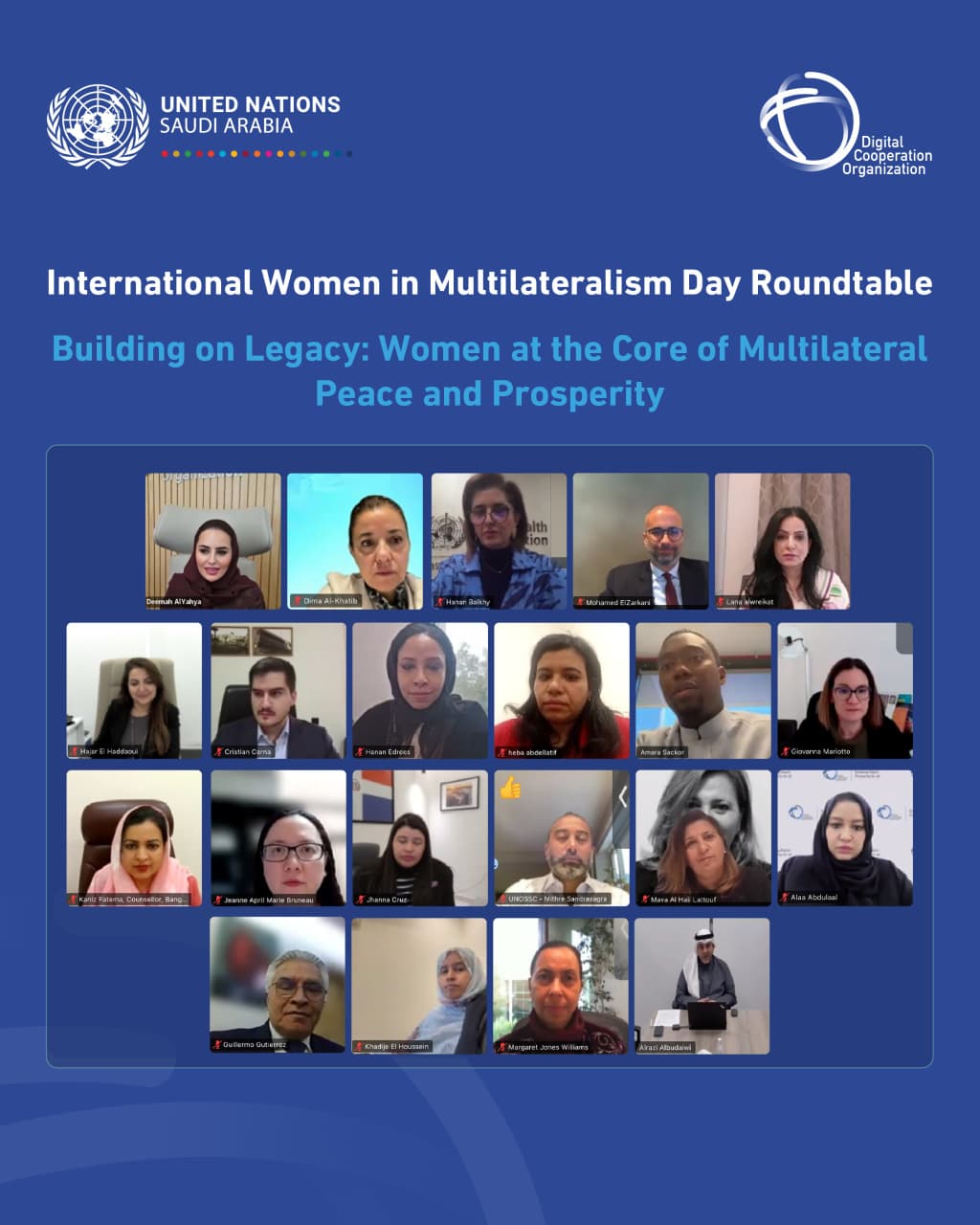
Riyadh, Saudi Arabia | 25 January 2026 – The Digital Cooperation Organization (DCO), in collaboration with the United Nations in the Kingdom of Saudi Arabia, convened a high-level virtual roundtable on the International Day of Women in Multilateralism, under the theme: “Building on Legacy: Women at the Core of Multilateral Peace and Prosperity.”
Peace agreements are 35% more likely to last at least 15 years when women are meaningfully involved in negotiations, according to UN-system analysis. Yet women have represented less than 15% of negotiators and fewer than 10% of mediators in major peace processes over past decades.
The roundtable brought together senior leaders from multilateral institutions, policy-making bodies and global thought leadership networks to translate this proven impact into actionable policies for today’s challenges—including digital transformation, economic fragmentation, and emerging technologies that are reshaping global cooperation.
“We are not only celebrating women’s legacy in multilateralism, we are claiming women’s future in it,” said DCO Secretary-General Deemah AlYahya. “When women make up half of the world’s population, half of its talent, and half of its perspective, their underrepresentation in global decision-making isn’t just wrong, it wastes leadership, credibility, and impact the world desperately needs. The evidence is in: when women lead, peace lasts longer, institutions grow stronger, and multilateralism becomes not only more inclusive, but more effective. The question before us is not whether we can afford to make this change. It’s whether we can afford not to.”
The United Nations Resident Coordinator in the Kingdom of Saudi Arabia, Mohamed El Zarkani said: “International Women in Multilateralism Day reminds us that inclusive leadership is not an aspiration—it is a requirement for effective multilateral action. Across peace processes and global decision-making, the evidence is clear: when women are meaningfully included, agreements are stronger, implementation is more durable, and communities are more resilient. The United Nations in the Kingdom of Saudi Arabia is pleased to collaborate with the Digital Cooperation Organization on this timely dialogue, which reinforces the vital role women must play in shaping multilateral solutions that deliver peace, stability, and shared prosperity for all.’’
“South-South and triangular cooperation offer trusted, peer-driven pathways to elevate women’s leadership, rooted in Global South experience and solidarity,” said Dima Al-Khatib, Director of the United Nations Office for South-South Cooperation, during the roundtable, highlighting that, “Through cooperation, women are helping shape the future of multilateral peace and prosperity.”
At a time of heightened geopolitical tension, multilateral institutions face growing pressure to deliver practical outcomes that sustain peace, stability, and inclusive economic opportunity. Despite evidence that women’s leadership materially improves peace outcomes, women remain significantly underrepresented in major peace processes globally.
The discussion examined how women’s leadership in past peace processes can address today’s geopolitical, economic, and technological disruptions, and how to build future multilateral cooperation models that embed women’s participation as standard practice rather than exception.
Participants identified women as essential stabilizers in complex negotiations, with lived experience serving as a strategic asset in building trust across divided parties. The roundtable concluded that achieving peace and prosperity in an increasingly fragmented global landscape requires women’s participation not as aspiration but as operational necessity.
For media enquiries, please contact media@DCO.org